
Juniper Service Provider: MPLS, BGP and VPN Services for ISP Engineers
Internet service providers and telecom operators build their backbones on MPLS. It lets them carry customer traffic across one shared core while keeping each customer's network separate and engineered for performance.
Juniper MX routers are common in these backbones, so MPLS on Junos is a valuable skill for anyone who wants to work at an ISP or telecom company.
Who should learn Juniper Service Provider (MPLS)?
- Engineers at ISPs, telecom operators and data center providers
- Juniper engineers who want to specialise
- CCNP-level engineers moving into service provider work
- Students targeting the JNCIS-SP level
What you will learn
- IGPs for service providers: OSPF and IS-IS
- BGP: iBGP, eBGP, route reflectors and policy
- MPLS fundamentals: labels, LDP and RSVP
- Traffic engineering, fast reroute and segment routing basics
- Layer 3 VPN with VRFs and MP-BGP
- Layer 2 VPN, VPLS and an EVPN overview
JNCIS-SP exam at a glance
| Exam code | JN0-364 (JNCIS-SP, Service Provider Routing and Switching Specialist) |
|---|---|
| Exam fee | US$300 |
| Prerequisite | JNCIA-Junos |
| Current version | Based on Junos OS 25.2 |
| Duration | 90 minutes |
| Questions | 65 multiple-choice questions |
| Language | English |
| Validity | 3 years |
Main exam topic areas
- Protocol-independent routing
- OSPF
- IS-IS
- BGP
- Layer 2 bridging and VLANs
- Spanning-tree protocols
- MPLS
- IPv6
- Tunnels
- High availability
Juniper publishes the exam objectives but not a percentage weight for each one, so give every objective real study time.
Career paths
Juniper Service Provider (MPLS) skills are useful for roles such as:
- ISP / backbone network engineer
- MPLS engineer
- Telecom NOC engineer
- Service provider implementation engineer
Service provider skills combine well with Junos automation for large-scale operations.
How to prepare
- Make sure your basics are solid. IP addressing, subnetting and routing fundamentals come up in every topic.
- Learn one topic at a time and lab it the same day. Configuration you have typed yourself stays with you far longer than notes.
- Break things on purpose. When a lab works, change one setting, watch it fail and fix it. This builds real troubleshooting skill.
- Keep your own notes and configs. A personal command reference is invaluable in interviews and on the job.
How GITN teaches Juniper Service Provider (MPLS)
At Global ITech Network, Juniper Service Provider (MPLS) is taught in live online classes by a working network security engineer, with every topic practised on PNETLab.
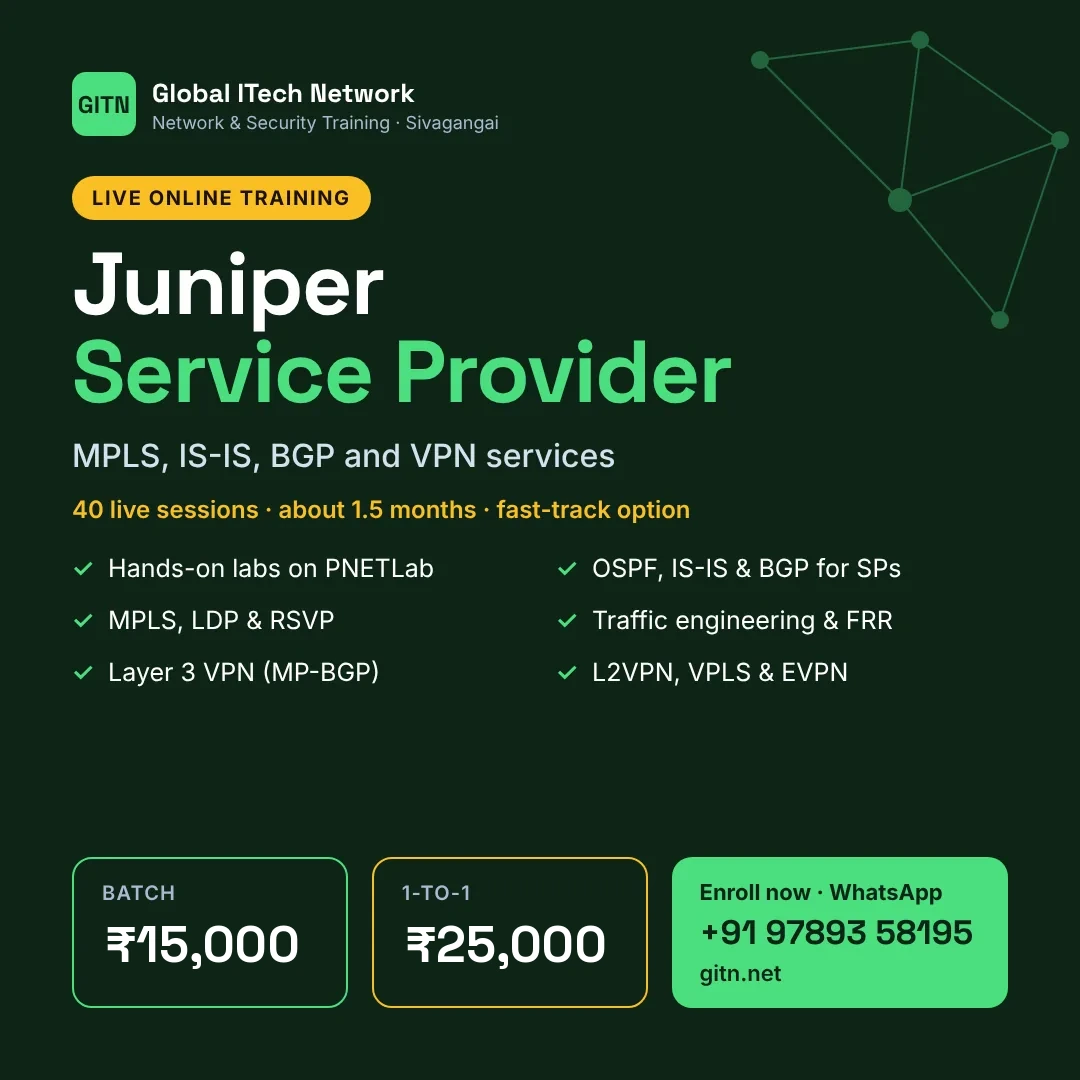
- 40 one-hour live sessions, about 1.5 months (fast-track: 6 sessions a week)
- Hands-on labs on PNETLab for every module
- Batch training at ₹15,000 or personal 1-to-1 training at ₹25,000
Frequently asked questions
Is MPLS still relevant with SD-WAN?
Yes. SD-WAN changes how enterprises connect branches, but ISP and telecom backbones still run on MPLS and segment routing.
Can MPLS be practised in a virtual lab?
Yes. The course uses a virtual lab with vMX routers.
How long is the course at GITN?
40 one-hour live sessions, planned over about 1.5 months at one hour a day. A fast-track plan with 6 sessions a week is also available.
Start Juniper Service Provider (MPLS) with GITN
Live online classes, hands-on labs and guidance from a working engineer. Message us for the next batch date.
Message on WhatsAppView syllabus and feesCourse details are taken from GITN's Juniper Service Provider (MPLS) syllabus page. Exam details were checked in November 2026 against vendor and training-provider sources. Vendors change fees, exam codes and versions often, so always confirm on the vendor's website before booking.