
VMware ESXi and vSphere: Virtualization Basics for IT Engineers
Instead of one physical server per application, virtualization lets one powerful server run many virtual machines. VMware ESXi is the hypervisor that does this, and vCenter manages many ESXi hosts together.
Most data centers and many office server rooms run on VMware, so virtualization skills are expected from system, network and cloud engineers alike.
Who should learn VMware ESXi?
- System administrators managing servers
- Network engineers who need to understand virtual switches and VLANs
- IT support engineers moving to infrastructure roles
- Engineers preparing for cloud and data center work
What you will learn
- Virtualization concepts and a vSphere overview
- Installing and configuring ESXi
- vCenter Server and inventory management
- Virtual machines, templates and snapshots
- Virtual networking: vSwitches, VLANs and NIC teaming
- Storage: datastores, iSCSI and vSAN
VMware VCP exam at a glance
| Exam code | 2V0-16.25: VMware vSphere Foundation 9.0 Administrator |
|---|---|
| Certification | VMware Certified Professional – vSphere Foundation Administrator (VCP-VVF Admin) |
| Questions | 60 questions |
| Duration | 135 minutes |
| Passing score | 300 (scaled) |
| Exam fee | US$250 |
| Language | English |
Main exam topic areas
- vSphere Foundation architecture and components
- Installation and configuration of ESXi and vCenter
- Virtual machine management
- Virtual networking
- Storage
- Operations, monitoring and troubleshooting
This is a short summary. See the vendor's official exam guide for the full list of objectives.
After Broadcom bought VMware, the certification path was rebuilt around vSphere Foundation and Cloud Foundation. The older vSphere 8 VCP-DCV exam (2V0-21.23) is now listed under legacy certifications.
Career paths
VMware ESXi skills are useful for roles such as:
- System / virtualization administrator
- Infrastructure engineer
- Data center operations engineer
- IT support L2/L3
VMware pairs naturally with Windows Server, and with data center networking such as ACI or EVPN-VXLAN.
How to prepare
- Make sure your basics are solid. IP addressing, subnetting and routing fundamentals come up in every topic.
- Learn one topic at a time and lab it the same day. Configuration you have typed yourself stays with you far longer than notes.
- Break things on purpose. When a lab works, change one setting, watch it fail and fix it. This builds real troubleshooting skill.
- Keep your own notes and configs. A personal command reference is invaluable in interviews and on the job.
How GITN teaches VMware ESXi
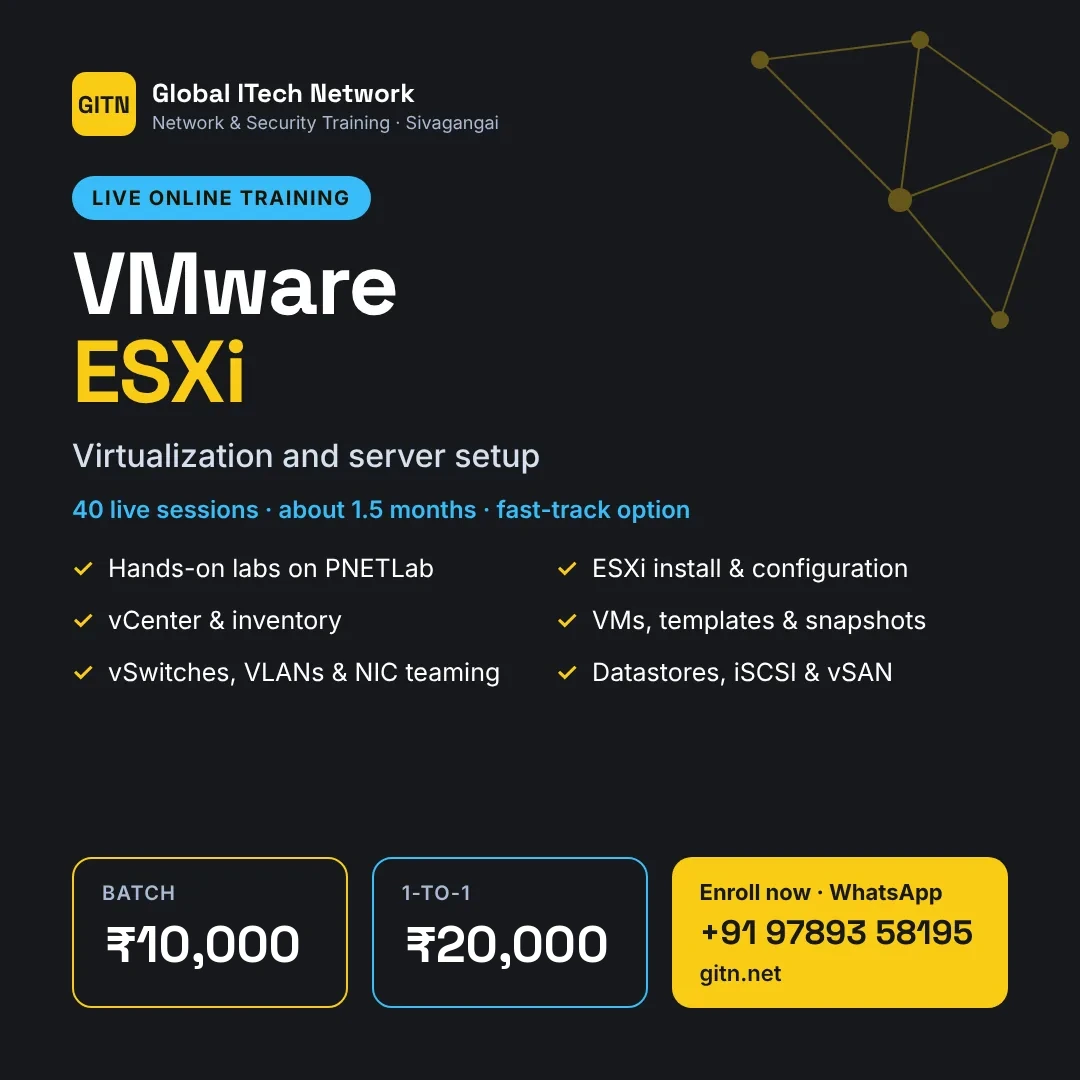
At Global ITech Network, VMware ESXi is taught in live online classes by a working network security engineer, with every topic practised on PNETLab.
- 40 one-hour live sessions, about 1.5 months (fast-track: 6 sessions a week)
- Hands-on labs on PNETLab for every module
- Batch training at ₹10,000 or personal 1-to-1 training at ₹20,000
Frequently asked questions
Do I need server experience first?
Basic computer and networking knowledge is enough to start. Windows Server knowledge helps.
Can ESXi be practised without a spare server?
Yes. ESXi can run nested inside a virtual lab for learning.
How long is the course at GITN?
40 one-hour live sessions, planned over about 1.5 months at one hour a day. A fast-track plan with 6 sessions a week is also available.
Start VMware ESXi with GITN
Live online classes, hands-on labs and guidance from a working engineer. Message us for the next batch date.
Message on WhatsAppView syllabus and feesCourse details are taken from GITN's VMware ESXi syllabus page. Exam details were checked in November 2026 against vendor and training-provider sources. Vendors change fees, exam codes and versions often, so always confirm on the vendor's website before booking.